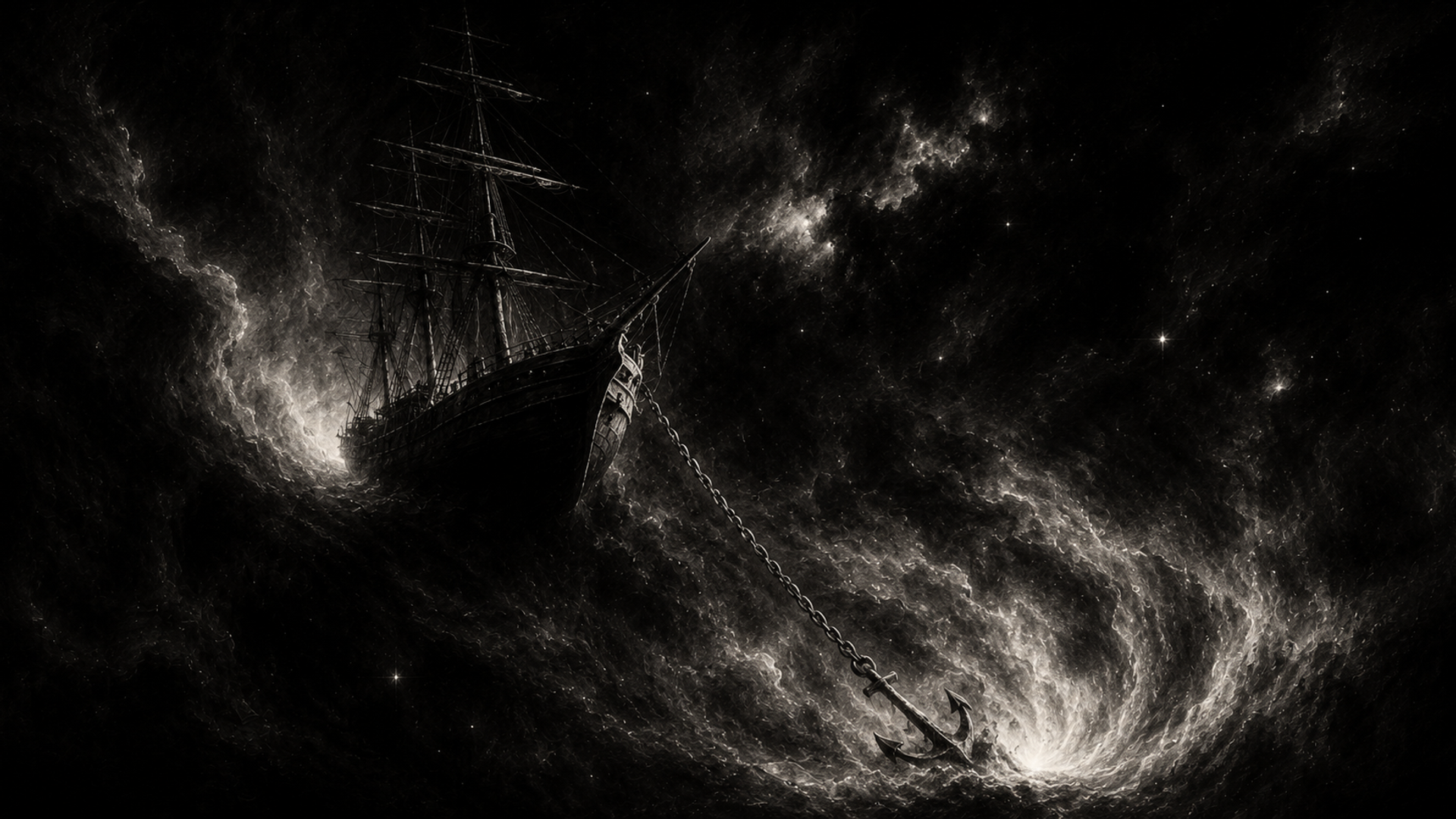
Where attention goes, the mind follows.
Lost in distraction,
we miss the brightest moments of life.
Unseen, unknown –
and never remembered.
Holy Paradox is a project exploring consciousness and non-dual thinking – and trying to make it comprehensible. In philosophy this direction has a name: panpsychism, the idea that consciousness is not produced by matter but constitutes the ground itself, and non-dualism, the recognition that the observer and the observed were never two. But the names matter less than what they point toward. What mystics sensed, religions distorted, and power exploited can neither be sold nor taught. It can only be pointed at – and recognised within yourself.
Holy Paradox is my attempt, after many years of searching, to do exactly that. But the choice to slow down, open up, and truly see – that one is yours.
The inner world runs on opposite rules. The harder you chase it, the further away it seems to move. The more you let go, the closer it comes.
Science and inner knowledge belong together
This site does not deny science. Science built the bridges, the satellites, and the medicine – and it keeps on building. This project adds the other eye: the inner world where all measurement finally lands. An eye turned outward sees the world. An eye turned inward sees the one who experiences the world. With both open, existence gains depth.
But every vantage point has its blind spot – research included. That blind spot has a name: scientism. The stance that only the measurable is real. There the method becomes self-referential – the instrument decides what exists, and whatever will not submit to measurement is sorted out of the whole before questions have even been asked.
The method is powerful within its domain. The mistake is confusing the domain with everything. Serious researchers know this. In common speech the method has nonetheless become a creed: “I believe in science.” Other people’s measurements of other people’s experiences are allowed to count as wisdom – while one’s own sight and one’s own reasoning go unused.
This is not religion. The “Holy” in the domain name points not toward dogma or anything requiring belief – rather toward what the religions once tried to capture. One of the book’s load-bearing ideas is precisely that movement: living insight hardens into form, form becomes story, story becomes dogma. What was meant to liberate begins to control.
The one book that can never harden into form is already in you – and it can only be read there.
A world in change
The world is undergoing a shift.
People sense that something is not quite right. And even when they perceive that a change is under way, attention is still directed outward. That is hardly strange – for centuries we have built our understanding on the external: the measurable, the material, the scientific. Along the way something fundamental slipped into the shadows: the inner world of consciousness.
But nature is cyclical. We find, then we forget. Later we find again. And now we are here again – hopefully in the best possible way.
The long detour outward
After the Second World War (00) the imperative was to build (01). To rebuild, grow, and produce. The outer world (01) was not merely a priority – it was a moral necessity. The inner (10) had to wait.
Science followed the same movement.
And yet some of physics’ sharpest minds were already pointing elsewhere. Planck, Schrödinger, and Bohr had reached the edge of something the materialist worldview could not contain. Schrödinger wrote explicitly about consciousness and non-dualism. Planck regarded consciousness as fundamental – matter, in his own words, as derived from it.
But the world was not listening. It was focused on other things.
Decades passed. The building continued.
The question that refused to stay buried
Then the question slowly began to return.
David Chalmers put words to what many had felt but could not articulate – the hard problem of consciousness: why do physical processes give rise to subjective experience at all? The question has stood open ever since – and the argument over it is live. Where I stand myself is evident from all of this: both eyes open.
Roger Penrose and Stuart Hameroff proposed that consciousness is a fundamental property of reality, operating at the quantum level.
The outer world built what needed building. Now the cycle continues.
What the early physicists sensed, and what the postwar decades set aside, is becoming a legitimate field of research once more. Because the questions themselves keep pointing inward.
When both eyes finally open (11)
Modern physics speaks of quantum entanglement. The old traditions spoke of yin and yang. Two languages circling the same intuition: that separation is never the whole picture.
Opposites are the same movement seen from two directions. Each becomes intelligible only through its opposite. And still most of us live as though one side must annihilate the other.
This project is my attempt to reopen what we have forgotten: the inner connection that makes the outer world intelligible.
This is not for everyone – and that is entirely fine
We are so unaccustomed to thinking in this direction that most people either fall asleep over it or dismiss it outright. And honestly – it should be neither preached nor imposed. Because the further you go, the clearer it becomes that this is deeply personal.
That inner and outer knowledge belong together is really no stranger than the fact that we have two eyes and two ears. Together they give us depth perception and stereo hearing. With both, you simply navigate your experience of the world better.
A note on how to read this
Do not read this as information. Read it as a pointer. Words are never the truth. But follow where they point – and see for yourself.
