Why does life feel empty even when everything looks fine on the surface? Why do the same patterns, the same conflicts, the same unease keep returning? What is actually going on inside me when I'm not doing well? If you carry questions like these, you've probably noticed how hard it is to get honest help with them – without someone also trying to sell you a lie. Holy Paradox is my attempt to take a different path.
Before you read on, I want to be clear about one thing. I write this primarily for my own sake. Insights behave like dreams – left unintegrated, they dissolve, and all that remains is a vague sense that something important flickered past. Writing is my way of integrating: giving the insight form before it fades, documenting the movement of consciousness – and then being able to let it go.
This comes with three bonuses for you as a reader:
- You can trust that these texts are written with honest intent.
- You can trust that I've spent more years on these questions than most people would have patience for.
- The information is free. No course, no membership, no one clamoring for your attention.
Unfortunately, most people choose the simplified version. Mainstream. It's understandable – simplifications are easy to reach and demand little of us. But the problem is what happens over time. Mainstream on top of mainstream on top of mainstream leaves people unable to find what they're looking for. Attention is constantly pulled outward, toward the next distraction, the next opinion, the next thing to consume. And it does feel safe – surely what costs $50 a month must be better than what's free? So the search continues, receipt in hand. The connection to the inner world thins out until it's barely there.
The problem with truth is that it's dead silent. It doesn't entice, it doesn't shout, it sells nothing. To become sellable, it has to be diluted with a generous share of lies: gilded, packaged, dressed in illusion. And the glitter is what people fall for. Not the content. Truth and illusion are the same coin – and we happily buy the shiny side. The wrong side.
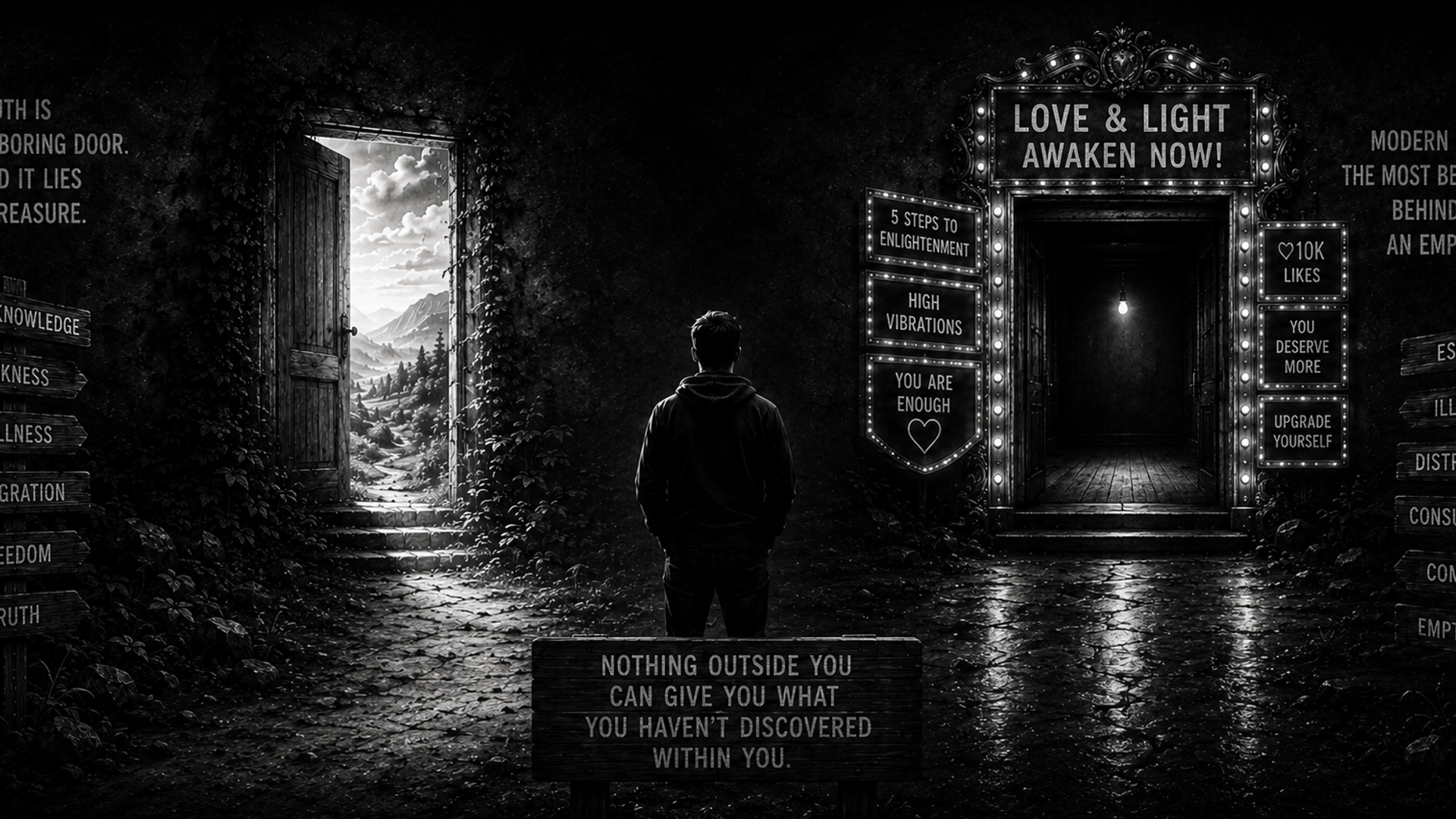
This applies to spirituality itself. Much of what's sold as spirituality is in fact a packaged, capitalist version of it – a shadow. Courses, retreats, quick techniques, promises of enlightenment in five steps. The form remains, but the direction has reversed: what was meant to point inward has become one more product in the outer world.
It shows most clearly in the bright variety. "Love and light" – only positive thoughts, only high vibrations, everything dark sorted out as "low energy." It sounds beautiful. But look closer: it's escape under a new name. The same old fear, now with incense. The ego has found its most refined costume yet – for who can accuse the light? You float above your own darkness and call the altitude growth. But what you refuse to look at goes nowhere. It waits. It rules quietly – choosing your relationships, writing your reactions, driving your flight – and the longer you float, the harder the ground becomes on the day the lift runs out.
Genuine inner work goes the other way. Downward. Straight into what the whole bright facade was built to avoid. Darkness has its place: it takes from you what you thought you were, and that is where something real can begin. But no one goes there willingly, and above all – it cannot be sold. No one signs up for a course titled "Be swallowed by a black hole. Return cannot be guaranteed." Course content: first you're torn down. Then we'll see. Becoming who you are costs something worse than money.
A rule of thumb that rarely fails: whoever shouts the loudest has the least to say. The genuine is recognized by its calm. It needs no customer.
You could say that truth looks like the dullest door – too dull to draw attention. But behind it lies a treasure. The present age is the opposite door: richly ornamented, impossible to miss – and it leads to an empty room. We build perfect boxes, but have nothing to fill them with.
Truth is the dullest door.
Behind it lies the treasure.
The present age is the most beautiful door.
Behind it lies an empty room.
I could, a little overdramatically, claim that the inability to see both sides of the coin resembles a kind of hell. A state of consciousness. No fire, no demons – just a person who has lost touch with themselves and searches for the answer everywhere except where it is. It works as long as the needs are met, but sooner or later a moment comes when the outer world stops delivering. A loss, an illness, an emptiness in the middle of success. Then you stand there with one side of the coin in your hand – and discover that all your preparedness lies in the world that just failed you. The inner world, which could carry you, is unknown ground. That is where the lostness becomes total: every tool you own points outward, and the problem sits within.
Here are some concrete ways the texts on Holy Paradox can affect you:
- You find words for what you feel. Much of our suffering is amplified by our lack of language for it. When you can put words to an inner state, you gain distance from it. You're no longer inside the storm – you can see it.
- You learn to separate the situation from your way of meeting it. Sometimes you need to change your situation. Sometimes you need to change how you meet it. We often confuse the two and get stuck ruminating. The texts help you see which path is open right now.
- You start to see your own patterns. Conflicts, worry, and discontent tend to run in the same grooves, year after year. When you recognize the pattern, you can begin to choose differently. What was automatic becomes a choice.
- You grow gentler with yourself and others. When you understand that every person sees the world from their own point – and that no one sees the whole picture – it becomes harder to judge. Both others and yourself. That frees up an enormous amount of energy otherwise spent on being right.
- You find a different relationship to change and loss. Everything moves in cycles. Periods of darkness often precede periods of clarity. Knowing that, you can rest through difficult phases instead of fighting them in panic.
- You find your way back to stillness. The world constantly pulls your attention outward. The texts remind you to turn your gaze inward now and then – and give you tools to understand what you see there.
Is it difficult?
Yes. But not in the way you're used to. Here, the point is to let the answers come to you. Knowledge is chased down; insight arrives when you stop. Stopping is something the modern world rarely has time or patience for. You already know it's true: your best ideas come in the shower, on a walk, or right when you've given up and are thinking about something else. Never while you're staring at the problem.
What this site points toward lies one step behind that. The shower thought is still a thought – an answer surfacing in the mind. But something received it. Something saw it coming. The deeper insight concerns that which sees – the place thoughts arise from, rather than one more thought for the collection. The same movement the shower taught you, just further in.
As an old Zen saying goes:
"Meditate for 30 minutes a day. If you don't have time for that – meditate for an hour."
And that quote captures the approach required. When you still the mind, you eventually discover something: a large share of your stress comes from the thoughts themselves. They paint disaster scenarios, demand that you do this or that, and keep up a tempo that feels necessary. Seen in stillness, the scenarios turn out to be just thoughts – a mind that was never allowed to rest. When the thoughts are allowed to rest, the world grows softer and you see more clearly.
Realizing such a thing is a good beginning. Even if there's still some way to go before understanding that everything is as it should be in any given situation, and that good and evil are the same movement seen from two directions. Equally important. If that sentence feels wrong, you have two choices: close the page, or find out why it chafes. The second choice is this entire site.
Welcome to the paradox.
