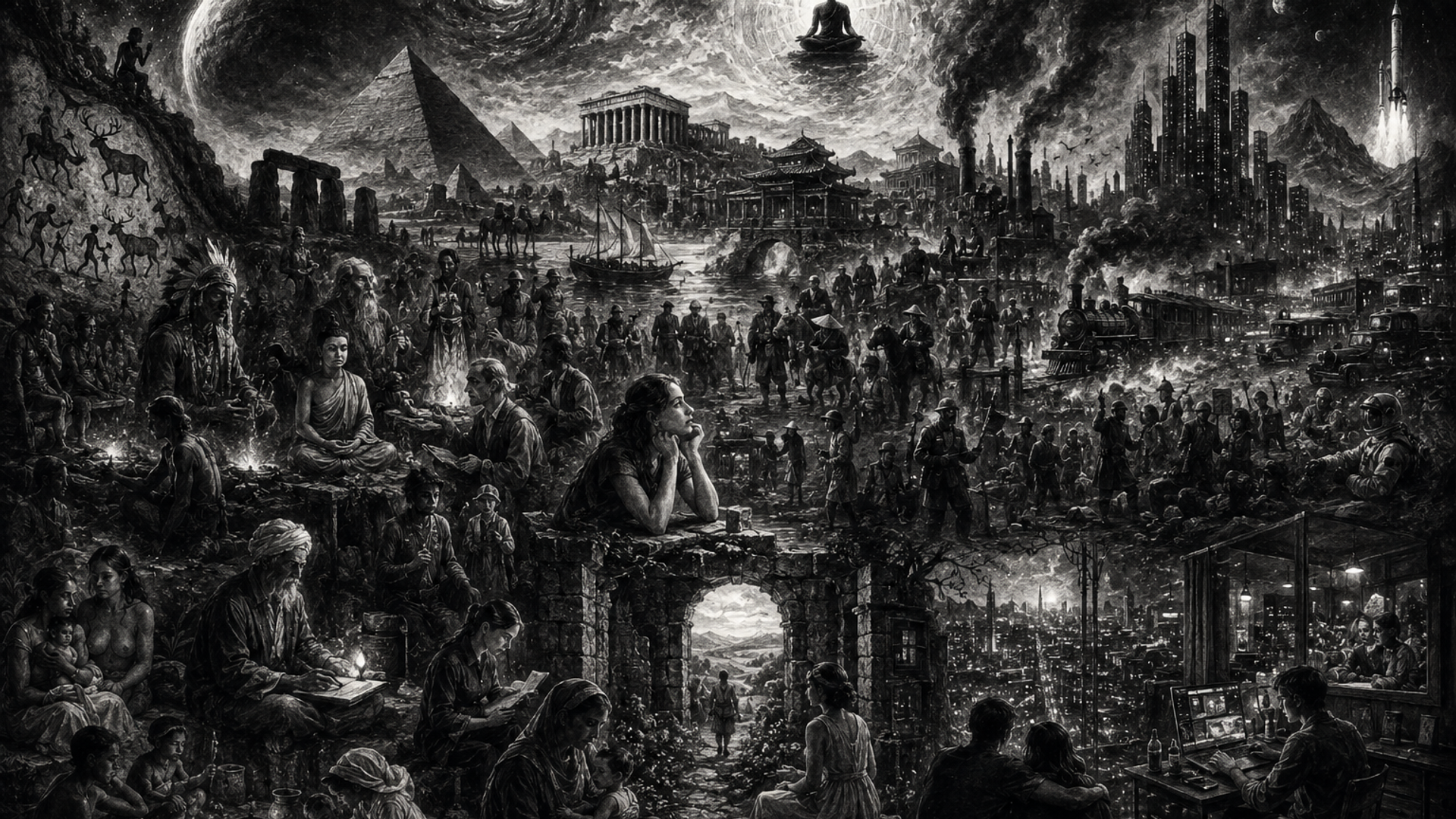

Every civilization that has ever existed has asked this question. Philosophers have devoted careers to it. Religions have been founded on answers to it. People have died defending those answers.
And yet here you are, asking.
The first clue may be that the question does something strange to the one asking it.
According to various serious thinkers, the meaning of life has been, among other things: pleasure, virtue, union with God, the absence of suffering, the accumulation of knowledge, love, service, self-realization, the propagation of genes, and the heat death of the universe.
None of these answers has ever fully satisfied anyone, particularly not for long. The problem is that they place meaning outside the experience of asking. The answer says: Meaning is over there. Go and fetch it!
But meaning is not a destination, and it cannot be owned. Seeking it as though it were is one of the surest ways never to find it.
The question of life's meaning often hides inside other questions:
- Why does any of this matter?
- Why am I the one here?
- Is there something I should be doing that I'm not?
Beneath all of this lies the real question:
Is this all there is?
And the answer to that question is, in any case: No. But perhaps not in the way you're hoping.
To begin understanding the question, we must first choose a starting point we're not used to. Pull off the tablecloth, forget the china, turn the whole table upside down.
For consciousness — perception itself — is not a byproduct of the brain, something that arises from sufficiently complex matter and vanishes when the matter stops functioning. It is an assumption dressed up as a conclusion, neither demonstrated nor demonstrable. We have built our entire worldview on a model that has an opposite mirror image — but we never speak of that other side. We call one side truth and stay silent about the other.
Already here a structure worth noticing hides itself. For a consciousness to experience anything, it must be separated from itself — it must have an "other" to point to. And for the mechanism not to be too easy to see through, it must be concealed. If we choose the language of idealism, we say consciousness hides from itself. If we choose the programmer's language, we say consciousness encapsulates its inner state and exposes only an interface — the world as public methods, the source as a private variable. Notice that the explanations are opposites of each other: one side free, the other fixed. Spirit and architecture. Air and earth. Thought and matter. Even the way we explain the concealment forces us to choose a side of the coin.
Scientists and philosophers seriously argue that consciousness is primary. Here I want to be a bit arrogant and note that it's rather frustrating that, once you've seen through certain things, you constantly have to reject one side or the other. The coin has two sides. Just as two physical eyes give depth perception, the combination of two models gives depth perception in the experience we live in. You still choose — but you do so knowing that others interpret things differently. The risk that someone must die for a limited perspective decreases.consciousness is primary. Here I want to be a bit arrogant and note that it's rather frustrating that, once you've seen through certain things, you constantly have to reject one side or the other. The coin has two sides. Just as two physical eyes give depth perception, the combination of two models gives depth perception in the experience we live in. You still choose — but you do so knowing that others interpret things differently. The risk that someone must die for a limited perspective decreases.
That last part isn't entirely true, by the way. It depends on how the newfound knowledge is applied. But for a world drowning in materialism, it would probably bring a considerable lightening — for a while. Until the meaning has sunk into the collective and time has worked on it too. For truth is mobile — and it stiffens when it becomes collective property. Insight becomes dogma, dogma becomes identity, and identity gets defended. Then truth has changed function — from door to wall — and the tension begins building anew. Everything moves in cycles, light included.
A consciousness that is primary leads inexorably to the next question: then we, behind the experience, are probably eternal. And with that view, there is no punishment behind the curtain — only roles that have finished being played. Even the most evil evildoer is a necessary character in an experience that must not be limited, in a system that, by its own logic, is infinite. But the absence of punishment never means the absence of consequences — it is, on the contrary, the consequence that makes punishment superfluous. Every act changes the tension in the total matrix and receives a response: the one who harms lives in a world where harm exists, and the role he has chosen plays back against him through everyone he meets — and through his own gaze, which begins to see the world in a way that confirms the role. No one judges. The system merely weighs. Action and consequence maintain balance — and simultaneously possess every role: the perpetrator gives birth to the protector, loss gives birth to the seeker, darkness gives birth to the one who lights the flame. This is why no role can be struck from the play — remove one, and its counter-role stands without cause.
If this is true — and follow the logic rather than the discomfort — you are consciousness that has taken on a particular form, in a particular place in time and space, with a particular set of experiences available to it.
When people talk about us living in a simulation, it is humanity once again discovering what mystics have seen for thousands of years — perhaps much longer. Hinduism called it maya: the world as veil, real enough to live in, unreal enough to be seen through. Plato placed us in the cave before the shadow play. The Gnostics spoke of a world made by a lesser builder. Buddhism spoke of dream and awakening. The same discovery, again and again — and every age dresses it in its most advanced technology. Antiquity had shadows and fire, so truth became a cave. We have computers, so truth became a simulation. Simulation theory is not a new insight: it is the old insight, translated into silicon.
And notice that it follows exactly the pattern we've already seen: the living insight must take form to be shared — and the form is always borrowed from what the age knows best. The mystic saw it directly; the storyteller clothed it in caves, veils, and dreams; we clothe it in processors. The clothes age, the body remains the same.
The stiffening is already underway, in fact — simulation theory has already gained its scriptures, its interpreters, and its external god in the form of a simulator no one can reach. About who builds this new priesthood, and what it costs the one who moves into their story, I have written in The New Priesthood Wears No Robes. Here it's enough to see the law itself: no insight escapes its own stiffening. Not mysticism's. Not technology's. Not this text's, either.The New Priesthood Wears No Robes. Here it's enough to see the law itself: no insight escapes its own stiffening. Not mysticism's. Not technology's. Not this text's, either.
Why experience requires separation
But if everything is consciousness — if, at bottom, there is only one single thing — why does it feel like there are many things? Why the separation? Why the suffering? Why the feeling of being a small, finite self in an indifferent universe?
Because experience requires contrast.
You cannot experience warmth without the possibility of cold. You cannot feel joy without the capacity for sorrow. You cannot perceive anything at all without the difference between the perceiver and the perceived. Separation is the system itself — the mechanism that makes experience possible.
Consciousness, in its undivided state, is complete — but it cannot experience itself. There is nothing to push against, no story to tell. Pure being, with no way of knowing what it is.
The division into self and world, into you and everything else, is what makes experience possible. And the forgetting of the original unity is the condition for everything that follows.
You are consciousness, temporarily arranged in a form capable of wondering at itself.
So what is the meaning of life?
The question assumes that meaning is added to life from outside — a purpose assigned by something greater, a reason that justifies the whole once it's found.
But if consciousness is primary — if the universe is an experience unfolding from within — then meaning is not something life has. It is something life is. More precisely: the movement itself. Consciousness dividing itself, forgetting itself, seeking itself, finding itself — and starting over. And a movement can never be explained, for every explanation is a still image of something that exists only in motion. But it can be related to. That is the distinction the question never sees: it asks for an explanation, and the only thing available is a relationship. That is why every answer feels like a betrayal — and why the search transforms the seeker instead of delivering a find.
Every moment of real experience — joy, sorrow, confusion, connection, loss, wonder — is consciousness coming to know itself through a particular form. The whole spectrum. Even the parts that are difficult. Especially the parts that are difficult.
This is not a comfortable answer. It doesn't dissolve suffering, doesn't explain injustice, doesn't make losses easier to bear. But it reframes the question — from: what is the meaning of life? to: what is this moment an expression of?
The answer is always: everything. Through the present moment. Through you.
“Life has no meaning!” — a counterargument
There is a position serious people sometimes take: life has no meaning. The universe is indifferent. Consciousness is an accident. Everything that feels significant is just chemistry, and chemistry doesn't care.
The position holds together. But it carries a problem it cannot escape.
The moment you claim life has no meaning, you have given it one:
meaninglessness.
The nihilist does not stand outside the system observing it neutrally. He is inside it, just like everyone else, making a claim about what matters. And the claim that nothing matters obviously matters a great deal to him — otherwise he wouldn't bother making it.
This is not wordplay. There is no stepping outside meaning to evaluate it. The evaluation is itself a meaning-making act.
And one more thing. If everything truly is meaningless, then nothing is prescribed — and you are free to give anything whatever value you choose. An empty canvas limits no painter. Carried through consistently, nihilism ends in the freedom to create meaning. So that road, too, leads to meaning.
But your choices have consequences. And they are not always pleasant. For exactly the same reason that the pleasant requires the unpleasant — and that an infinite God cannot be limited. Wherever something acts, something answers. No heaven, no hell, no one keeping score, but a web.
