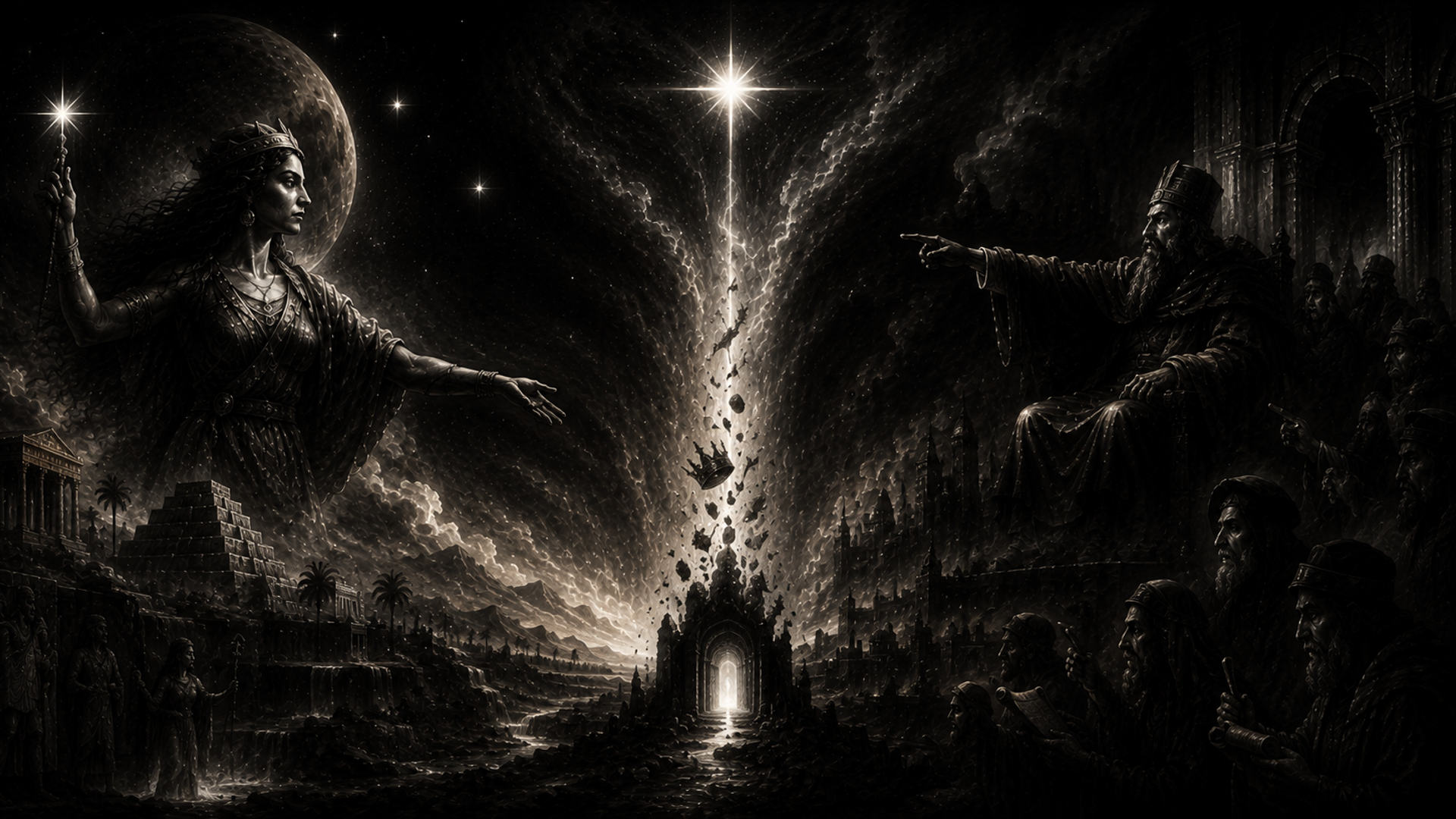

1. The pattern lives in the body before any story
Before any of this became myth, it was biology. Every human being who has ever existed came into being through separation from a woman's body. For something to exist, it must be parted from its origin – the umbilical cord is cut. No one enters the world standing – the child falls, head first, through the gate. And the pain of childbirth is precisely the price of one new consciousness being separated out of another.
It is this pattern – the separation, the descent, the gate, the price – that humanity's myths have retold again and again, in ever more abstract forms. The fall is not, first and foremost, a story. It is a bodily reality that later became a story. And that body is a woman's.
This is worth keeping in mind throughout the history that follows, for that history is about how the pattern was step by step lifted out of the body, recoded into male princes and angels – and how the real gate was finally left to bear the shame.
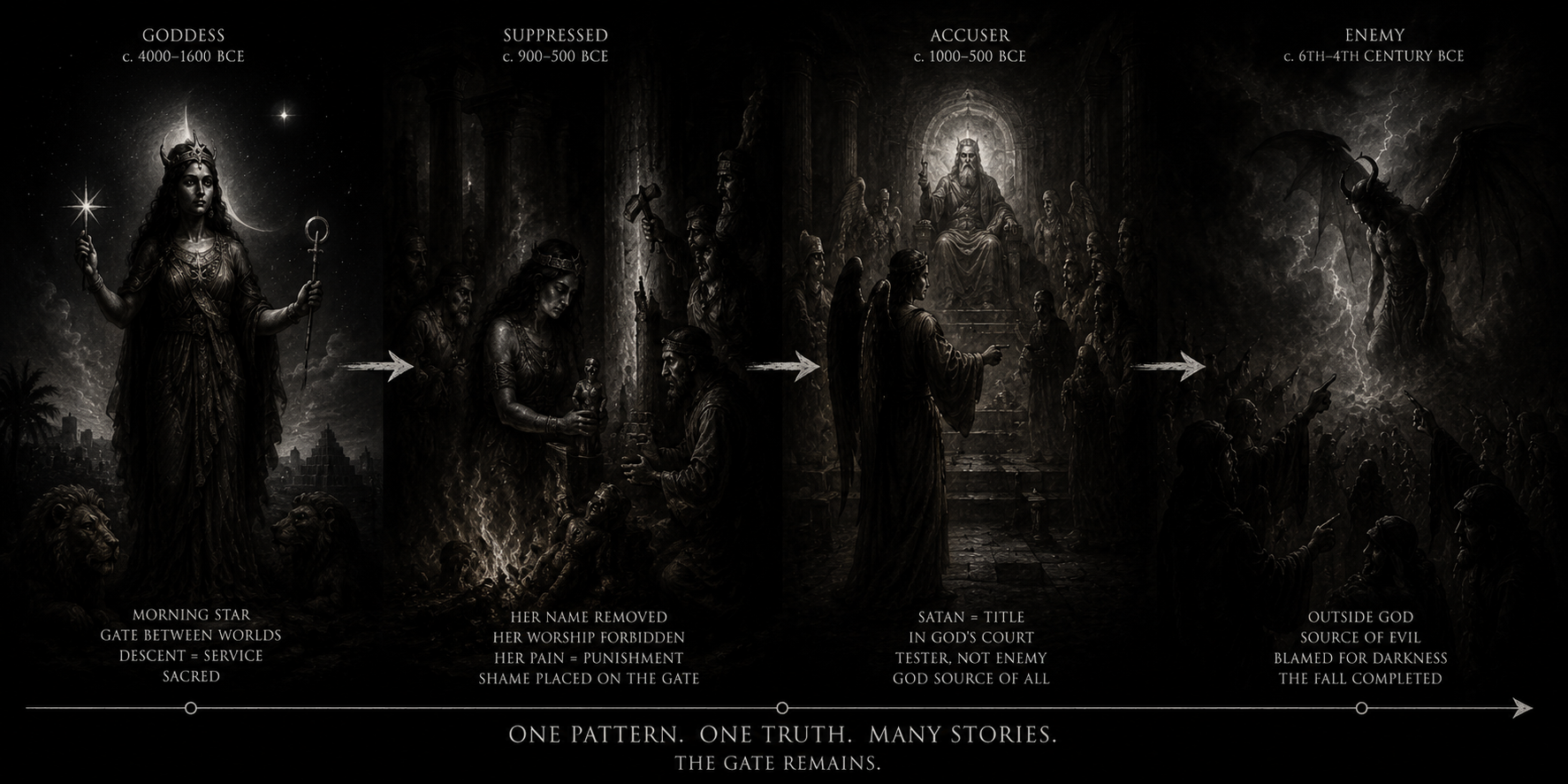
2. The morning star was a goddess (c. 4000–1600 BCE)
The oldest known figure of Venus – the morning and evening star, the star that rises before dawn and sets before all others – is not a fallen angel but a goddess: Inanna in Sumer, later called Ishtar in Babylonia, worshipped from at least 4000–3500 BCE and thus one of the oldest deities known to us at all.
Her most famous myth, recorded on clay tablets c. 1900–1600 BCE, is the Descent of Inanna to the Underworld.
Note what the myth says in its oldest form: the descent is voluntary. It is not a punishment but a passage – a service with a price. The Venus figure who goes down into the darkness and comes up again is here neither evil nor fallen. She is the gate between the worlds, and the movement through the darkness is sacred.
3. The goddess who was written out (c. 900–500 BCE)
Early Israelite religion also knew the feminine divine. Archaeology has made this hard to deny: inscriptions from Kuntillet Ajrud (c. 800 BCE) give blessings, in plain words, by "Yahweh and his Asherah". The goddess Asherah, the Canaanite mother goddess, was worshipped at Yahweh's side, and her cult poles stood in the temples until reformer kings such as Hezekiah and Josiah (8th–7th century BCE) had them cut down.
The Bible itself bears witness to how stubborn the purge was. The prophet Jeremiah (chapters 7 and 44, c. 600–580 BCE) rages against the people – and especially against the women – who insist on baking offering cakes for the "Queen of Heaven", a Venus goddess in the line of Ishtar. The women answer him defiantly that things went better for them when they were still allowed to make offerings to her (Jeremiah 44:17–18).
At the same time, the feminine is recoded in the law and the primeval history. In Genesis 3:16, the pain of childbirth is turned into a punishment, imposed as payment for knowledge:
"In pain you shall bring forth children."
And in Leviticus 12, a woman is declared ritually unclean after giving birth – twice as long if the child is a girl. Read that slowly: the act that carries every new light into the world was classified as unclean, and its pain as guilt. The gate had begun to bear the shame.
4. The origin: a title in God's court, not an enemy (c. 1000–500 BCE)
In the oldest layers of the Hebrew Bible there is no devil. The word satan (Hebrew שָׂטָן) is an ordinary noun: "adversary", "accuser". It is even used of God's own angel, who places himself in Balaam's way "as a satan" (Numbers 22:22).
In the Book of Job, ha-satan – "the accuser", with the definite article, a title and not a name – appears as a member of God's heavenly court:
"One day the sons of God came to present themselves before the Lord, and the Accuser [ha-satan] was among them." (Job 1:6)
He is a prosecutor in God's service who tests Job's loyalty – with God's explicit permission. The same picture appears in Zechariah 3:1–2. And the decisive evidence that this theology was not dualistic is that God himself is described as the source of both:
"I form the light and create darkness, I bring prosperity and create disaster; I, the Lord, do all these things." (Isaiah 45:7)
In the beginning, God needed no counterpart. Everything – even the darkness – was contained within the one God.
5. The rewrite, documented in the Bible itself (6th → 4th century BCE)
The clearest evidence that the meaning changed is that the Bible contains the same story twice – with a different actor. In 2 Samuel 24:1, written before the Babylonian exile:
"Again the anger of the Lord burned against Israel, and he incited David against them, saying: 'Go and count Israel and Judah.'"
It is God who incites David. When the Books of Chronicles retell the same event after the exile (c. 350–300 BCE), it reads:
"Satan rose up against Israel and incited David to take a census of Israel." (1 Chronicles 21:1)
God has been replaced by Satan. Here the shift is visible in black and white: a later generation could no longer accept that God was the source of evil, so the uncomfortable part was moved onto another figure. What could no longer belong to God needed somewhere else to live.
6. Why right then? Persia (539–332 BCE)
Between the two versions, Persia happened. When Cyrus conquered Babylon in 539 BCE, the Jews came under Persian rule for two centuries. The Persian religion, Zoroastrianism, was built on cosmic dualism: the spirit of light and truth (Ahura Mazda) against the spirit of darkness and lies (Angra Mainyu). This figure of thought – absent from older Israelite religion – seeped into Jewish thinking. It is in the encounter with Persian dualism that the accuser in God's court begins his journey toward becoming God's enemy.
7. The hardening: evil takes shape, layer by layer (c. 300 BCE–100 CE)
The great construction takes place in Jewish writings that never entered the Hebrew canon, and it can be followed step by step.
The Book of Enoch (the Book of the Watchers, c. 300–200 BCE) develops the myth of angels who fell from heaven and taught humans forbidden knowledge. The leaders here are not called Satan but Azazel and Shemihazah; the angel who "led Eve astray" is called Gadreel. Evil has acquired figures, but as yet no single unifying name.
The Book of Jubilees (c. 150 BCE) calls the prince of evil Mastema.
The Dead Sea Scrolls (Qumran, c. 150 BCE–70 CE) show the dualism fully formed within a Jewish setting: the War Scroll describes the final war between the "sons of light" and the "sons of darkness", with darkness led by Belial. The Zoroastrian core figure – two spirits, light against darkness – now lives inside Jewish theology.
The Wisdom of Solomon (c. 50 BCE–50 CE, written in Greek in Alexandria) takes the decisive step and links the death in Eden to the devil:
"Through the devil's envy death entered the world." (Wisdom of Solomon 2:24)
This is a retroactive construction: in Genesis, the serpent is merely "more crafty than any of the wild animals". As the Biblical Archaeology Society dryly notes, Satan does not appear in Genesis 2–3 "for the simple reason that when the story was written, the concept of the devil had not yet been invented". But through this new reading, the story of knowledge in Eden receives its finished distribution of guilt: the devil behind the serpent – and Eve, the woman, as the one who fell for him and brought death upon the world. The bearer of knowledge and the gate are bound together in the same guilt.
During the same period, the Septuagint – the Greek translation made by Jewish scholars in Alexandria under Ptolemy II (c. 285–246 BCE) – had rendered ha-satan as ho diabolos, "the slanderer". Now the titles merge into a single name for one and the same figure.
8. Yes – it continued into the New Testament (c. 50–150 CE)
By the time the New Testament is written – Paul's letters c. 50–61 CE, the Gospels c. 70–100, the Book of Revelation c. 95 – the development is complete and taken for granted. No New Testament author argues that the devil exists; the reader is assumed to already live inside the dualistic story.
The contrast with Job is dramatic. The accuser who needed permission for every act has become "the prince of this world" (John 12:31), "the god of this age" who has "blinded the minds of unbelievers" (2 Corinthians 4:4), and "the father of lies":
"He was a murderer from the beginning ... When he lies, he speaks his native language, for he is a liar and the father of lies." (John 8:44)
In the desert he meets Jesus in single combat (Matthew 4, Luke 4). Ephesians 6:12 turns existence into a struggle against "the spiritual forces of evil in the heavenly realms". And in Revelation 12:9, all the threads are finally welded together:
"The great dragon was hurled down – that ancient serpent called the Devil, or Satan, who leads the whole world astray."
The serpent, the dragon, the accuser, the slanderer – a single figure. The fusion that took six hundred years is complete.
9. The name: how the morning star became the devil (700 BCE–1611 CE)
All that remained was to give him the light-bearer's name. Isaiah 14:12 (8th century BCE) mocks the fall of the Babylonian king with an astral image: helel ben shachar, "shining star, son of the dawn". Scholars hold that the image was borrowed from a Canaanite astral myth – in the Ugaritic texts there is the Venus god Attar, who tries to ascend Baal's throne, fails, and descends. Note that the Venus deity has changed sex here: female in Mesopotamia (Inanna), male in Ugarit. And the sign changed with the sex – Inanna descended voluntarily; Attar and Helel are cast down. The descent has become punishment. The passage has become hubris.
The Septuagint rendered helel with the Greek heosphoros, the dawn-bringer. When Jerome, commissioned by Pope Damasus, made the Latin translation known as the Vulgate (382–405 CE), he chose the Latin word for the morning star: lucifer – "light-bearer", in Latin an entirely innocent word, a common name for the planet Venus.
The link to the devil was forged by the Church Fathers. Origen (c. 184–253) read Isaiah 14 and Ezekiel 28 as a hidden story of Satan's primeval fall – even though the texts explicitly concern the kings of Babylon and Tyre. Justin Martyr, Tertullian and Augustine meanwhile cemented the identification of Eden's serpent with Satan. Through the Vulgate's thousand-year dominance, the King James Version's "Lucifer" (1611) and finally Milton's Paradise Lost (1667), the light-bearer's name became, definitively, the devil's.
And so a taunt against a Babylonian king – itself borrowing a Venus myth that had earlier still belonged to a goddess – came, through two steps of translation and one allegorical reading, to carry the entire myth of the light-bearer's fall.
10. The counter-current: Sophia and those who read it the other way (100–300 CE)
That the recoding was not inevitable is shown by the Gnostics. In their writings (100–300 CE, including the Nag Hammadi texts), it is Sophia – Wisdom, a female divinity – whose fall from the world of light gives rise to the material world. For them, the fall is not a crime but the very mechanism of creation, and the serpent in Eden is read as the liberator of knowledge, not as the enemy. The Church declared them heretics, and their writings were buried in the desert, where they were not found again until 1945. So the counter-reading, too, carried the feminine – and it too was made to bear the name of darkness.
11. Origin versus outcome
Now set the beginning against the end.
At the origin: the fall is a birth – the bodily separation through which every consciousness enters the world. The Venus figure who descends into darkness is a goddess, and the descent is voluntary, sacred, a service with a price. Satan is a title for an accuser in God's own court. God himself holds both light and darkness. The serpent is a cunning creature. The morning star is a Babylonian king.
In the result: the fall is a crime. The Venus figure is male, cast down and evil. Satan is God's cosmic enemy, identical with the serpent, the dragon, and Lucifer. God is light alone, and all darkness dwells with the adversary. The woman bears the guilt for knowledge, the impurity for giving birth – and the goddess is gone.
Every step can be dated and attributed. The reforming kings cut down the Asherah poles (7th–6th century BCE). The chroniclers replaced God with Satan (c. 350–300 BCE). The apocalypticists wrote the myth of the fallen angels (c. 300–200 BCE). The Qumran community divided the world into sons of light and sons of darkness (c. 150 BCE–70 CE). An Alexandrian Jew laid death at the devil's envy (c. 50 BCE–50 CE). The authors of the New Testament inherited it all as self-evident (50–150 CE). Jerome gave the figure the name Lucifer (382–405), and the Church Fathers from Origen to Augustine read the fall into texts that were about something else entirely.
No single person invented the devil. But each generation moved the pattern one step further from the body and one step closer to the enemy – until the movement that every birth repeats, the descent through the gate into darkness and time, had become evil's own biography. The story did not solidify because it was true, but because it was useful: it solved the problem of evil by giving it a face, a kingdom, and a name – and the bill was sent to the bearer.
It is this history the poem "The Fall" turns around. Not by claiming another history, but by reading the pattern back to its origin: the fall was never a prince's downfall. It was, and is, a birth. The gate through which every light is born was made to carry the shame – and whoever sees this already stands outside the story that assigned it.the poem "The Fall" turns around. Not by claiming another history, but by reading the pattern back to its origin: the fall was never a prince's downfall. It was, and is, a birth. The gate through which every light is born was made to carry the shame – and whoever sees this already stands outside the story that assigned it.
Sources
- Inanna – World History Encyclopedia
- Descent of Inanna into the Underworld – Wikipedia
- Asherah: Canaanite Mother Goddess and Consort to Yahweh – Brewminate
- Who's Afraid of the Goddess of Ancient Israel? – The Ancient Near East Today
- Who Is Satan? – Biblical Archaeology Society
- How the Serpent in the Garden Became Satan – Biblical Archaeology Society
- 2 Samuel 24:1 vs 1 Chronicles 21:1 – BibleHub
- Zoroastrianism in Second Temple Judaism and the Christian Satan
- A Brief History of the Septuagint – Associates for Biblical Research
- Wisdom of Solomon 2:24 – BibleHub
- The Mythological Provenance of Isaiah 14:12–15 (Ugaritic material)
- ʿAṯtar – Wikipedia
- Athanasius Lists the New Testament Writings – GCI
