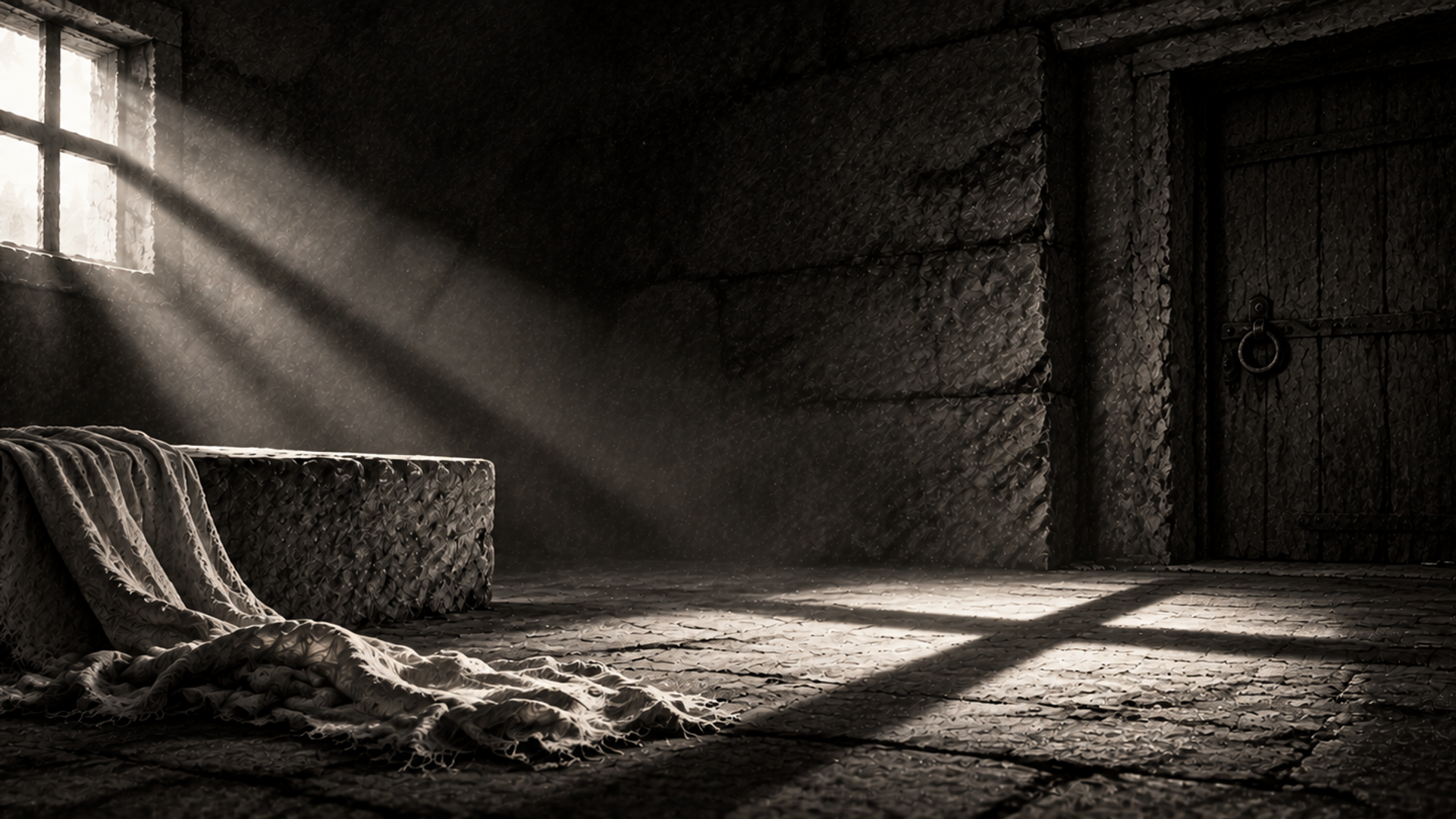
My first reaction to the Bible's literal narrative was outright rejection – a reaction against the shell and the outer dogma. But the further I looked beyond the literal, the more clearly the same pattern emerged. I realized the story was not a fabricated article of faith demanding blind belief, but an encapsulation of exactly the dynamic the poem captured: that the self wants to be saved as it is, while what actually liberates requires the self to fall.
The poem does not dismiss the story. What first looked like a reckoning with Christianity turned out to be the key to understanding it.
Let me begin by stating where I stand.
Christianity as a literal article of faith I still reject 100%. That a deity sends a son to be executed in order to cancel a debt, and that this should be held as true on the word alone, is not something I can accept.
By the dogma's own logic, such a faith comes closer to idolatry – and the accusation against the "godless" turns back on the one who makes it. It clings to the word, the outward, and misses the wordless inner reality the word was pointing to. That is exactly what the poem is about: meaning that hardened into form and was turned outward.
What I do not reject is the mechanism, the purpose, and the actual content. The story carries something genuine, with a precision that sharpens the further one reads beyond the letter. There, the divine reveals itself to me. Not a god who intervenes. Consciousness itself, on the other hand – that which precedes every name, that which creates.
That religions quarrel over literal interpretations is nothing new. Put simply, it is an argument with the neighbor over whose shadow has the correct shape. Shadows fall differently, but the stories follow the same movements. Trace them back and they converge – often into formulations so close to one another that their origin becomes irrelevant. Truth is fluid but eventually hardens into form. In the end the form is mistaken for the truth.religions quarrel over literal interpretations is nothing new. Put simply, it is an argument with the neighbor over whose shadow has the correct shape. Shadows fall differently, but the stories follow the same movements. Trace them back and they converge – often into formulations so close to one another that their origin becomes irrelevant. Truth is fluid but eventually hardens into form. In the end the form is mistaken for the truth.
But:
What divides lies in the shell.
What unites lies in the core.
None of this is meant to step on anyone's toes. The shell is not a failure. Those who hold the story literally are – from one perspective – mistaken in fact, yet at the same time carry the genuine thing. Unopened. By holding fast to the form, literal believers have preserved the core for everyone else. The only question is when the seed will open. And that is not decided by human will – the seed germinates when the ground is ready.
The poem above appears to dismiss the Christian story. It does the opposite. Truly. It shows the same core that I see – I have simply built a different project around it.
The text that follows sets out what is documented about the story of Jesus, what was added afterward, and why what was added looks the way it does.
What is documented
That Jesus was executed by crucifixion under Pontius Pilate is historically well documented.
Tacitus mentions the execution around the year 116, as a Roman historian hostile to Christianity. Josephus mentions it around the year 93. Paul writes about it as early as the 50s, referring to living eyewitnesses.
To this comes an internal argument. The cross was a punishment for slaves, a punishment of shame. Paul himself calls the message a stumbling block and foolishness. A fabricated messiah would not have been assigned that cause of death.
What was added afterward
The event is documented. Its meaning was shaped during the decades that followed.
Mark was written around the year 70, forty years later. John around 90–100. In between lay oral proclamation aimed at persuading, not documenting.
The passion narrative follows Psalm 22 and Isaiah 53 in detail. The event is told through scripture.
The gospels differ on what Jesus says as he dies. Mark has abandonment, Luke forgiveness, John fulfillment. Three theologies, the same death.
The differences show that the material was worked over. They do not show that the event was invented.
Why the reworking happened
Two reasons suffice.
The practical one
A group stood without its leader, executed as a rebel. Either the group dissolved, or the death was given a meaning. The tools were there in the Jewish tradition. No single person constructed the meaning. The phrasings that worked were repeated, the others fell away.
The communicative one
A message saying the self must dissolve cannot be received by the self. Stated plainly, it is rejected by the very thing that hears it. The question is how to spread something that cannot be received by the self, because it is so fundamentally alien to it.
The story solves the problem. In it, someone else dies in the recipient's place. It can therefore be carried forward by people who have never opened it, generation after generation, for centuries. The content remains unchanged inside.
What's interesting is that this same mechanism has already been described elsewhere in my project. In the poem "The Truth""The Truth"..
That the encapsulation is stated outright
The tradition itself says that it works in two layers. Compare the texts below with the poem above.
Mark's fourth chapter is the clearest instance. It opens with the parable of the sower. A man sows. Some seed falls on the path and is eaten by birds. Some falls on rocky ground and withers without roots. Some falls among thorns and is choked. Some falls on good soil and bears fruit. The seed is the same everywhere. It is the soil that decides.
The parable is told to a crowd. No interpretation is given. Afterward he withdraws with his closest followers, and there the reason is stated:
“To you has been given the secret of the kingdom of God, but for those outside, everything is in parables
Mark 4:11
The wording is a problem for any reading that assumes the aim was maximal clarity. Here the obscurity is deliberate. An outer layer is given to everyone, an inner layer to those able to receive it.
The same chapter also states the temporal relationship:
“For nothing is hidden except to be revealed
Mark 4:22
What is hidden is hidden so that it may be opened later. This is not an explanation after the fact but a description of the method, stated in the text itself.
The same thing recurs in several places. Paul speaks of a wisdom spoken only among the mature. Hebrews distinguishes milk from solid food. The formula he who has ears, let him hear repeats throughout the gospels and is addressed to a subset of the listeners.
The Gospel of Thomas opens with the same premise:
“Whoever finds the interpretation of these words will not taste death
Gospel of Thomas 1
The sentence presupposes that the words have an interpretation that does not lie on the surface, and that it must be found.
What is stated is that the material is sealed, that the seal is intentional, and that it is made to be broken.
The threat to power
The teaching is structurally incompatible with governance.
Whoever seeks the authority within needs no intermediary. Whoever is not afraid of death cannot be controlled by threat.
Rome grasped the threat immediately. Crucifixion was the punishment for rebellion and for slaves. The charge on the sign above the cross was political:
“King of the Jews
Roman practice was to state the crime on the cross. Rome executed for claims.
From the texts of Mark to John, Rome's responsibility for the execution steadily diminishes, while the responsibility of the Jewish leadership increases.
A plausible, or at least logical, reason for this is that the movement needed to be able to survive within the empire.
The flood and the ark
The decisive transformation happens later and is well documented. Christianity is tolerated in 313, receives its doctrinal definition at Nicaea in 325, and becomes the state religion in 380. Athanasius fixes the canon in a letter in the year 367. The find at Nag Hammadi, buried around that time, is often connected to that delimitation.
What remained was a teaching in which the work has already been done by someone else, and in which access is administered. The resurrection makes the figure immortal and thereby permanently accessible, but at the same time moves the act away from the reader.
An institution can only spread what it is able to steward. What could not be stewarded was not copied forward. The selection was the river. The story was the ark – sealed, its inner content preserved, carried by hands that did not know what they carried. For the future.
Resonances in the canonical text
The poem draws nothing from outside. Most of it is already in the text, beneath the layer that moves the action elsewhere.
The cross as the reader's own:
“If anyone would come after me, let him deny himself and take up his cross
Luke 9:23
“I have been crucified with Christ. I live, yet not I Galatians
2:19–20
The surrender:
“Whoever finds his life will lose it
Matthew 10:39
“You have died, and your life is hidden
Colossians 3:3
The price:
“He sells all that he has and buys that field
Matthew 13:44
The resistance:
“He came to his own, and his own did not receive him John 1:11
“The light came into the world, but people loved darkness more John 3:19
That the bearer must depart:
“If I do not go away, the Helper will not come to you
John 16:7
The seed:
“Unless a grain of wheat falls into the earth and dies, it remains alone John 12:24
The kingdom:
“The kingdom of God is within you Luke 17:21
A few more quotes belong here, though of a different kind. At the cross, the literal reading is already spoken aloud, by the first ones who did not see through it. Even the misunderstanding is preserved, documented at the very place where it arose.
The mockery from the crowd:
“Save yourself, if you are the King of the Jews
Luke 23:37
It assumes that salvation consists of stepping down – that the self survives. It is the line of the poem, shouted at the scene: the self wants to be saved as it is.
The mockery from the council:
“He saved others; himself he cannot save
Mark 15:31
True, in a way the mockers do not see. Himself he cannot save. There is no self to save.
The cry from the cell next door:
“Are you not the Messiah? Then save yourself and us
Luke 23:39
The demand that someone else open the door – without anyone having to let go of the one sitting there.
Both layers lie within the same book.
The empty tomb
Every gospel has the empty tomb. But an empty tomb asserts nothing. It is an absence, and an absence must be interpreted to mean anything at all.
“Why do you seek the living among the dead? Luke 24:5
The question locates the error in the very act of searching for a body.
The interpretation was never written into the image. The tomb remained empty in the text. The literal reading has therefore always been available: no one is there, and no one ever was. That reading could not be closed without removing the tomb, and the tomb could not be removed.
The Gospel of Thomas
The Gospel of Thomas contains 114 sayings on what Jesus actually said, and no narrative. No crucifixion, no resurrection, and no atonement.
The kingdom is described as already present, within and outside the reader. The work belongs to the one who reads. The Gospel of Thomas contains 114 sayings on what Jesus actually said, and no narrative. No crucifixion, no resurrection, no atonement. The kingdom is described as already present, within and outside the reader. The work belongs to the one who reads.
The text was excluded from the canon. The usual explanation is theological. A structural one is simpler: a teaching without a substitutionary death leaves nothing to administer.
What is divine in it
After all this, the question remains what the word divine could refer to.
No god is needed for the process above. The spread is rational through and through: the story was simplified and shaped to be carried through time. Like a seed pod. The divine sits in the understanding of the content — in what the story points toward: consciousness, the strength within. No form can bring about that understanding. No institution can administer it.
So there are really no wrong believers. There are carriers and receivers. The carrier held the form to be true and thereby helped carry the seed pod forward. The receiver sometimes sees through it and receives, two thousand years later.
Not everyone sees through it. That is not the point. The sowing is broad. The seed germinates where it can.
Understanding does not come on demand. It comes when conditions allow it. There is no merit in whoever happens to be standing there when it happens.
The Paradox
The poem appears to turn against the story. It does not. It has received the understanding and unpacked it.
It accuses no one. It only says what lies beneath: that the cross is the reader's own, that the tomb has always been empty. This is not an objection to the story. It is the story, opened.
And the opening presupposes what it opens. The Gospel of Thomas survived by chance, in the sand. The canonical story survived by being copied through seventy generations, sealed, by an institution that did not know what it carried.
Lift the stone, and you will find me
Gospel of Thomas, 77