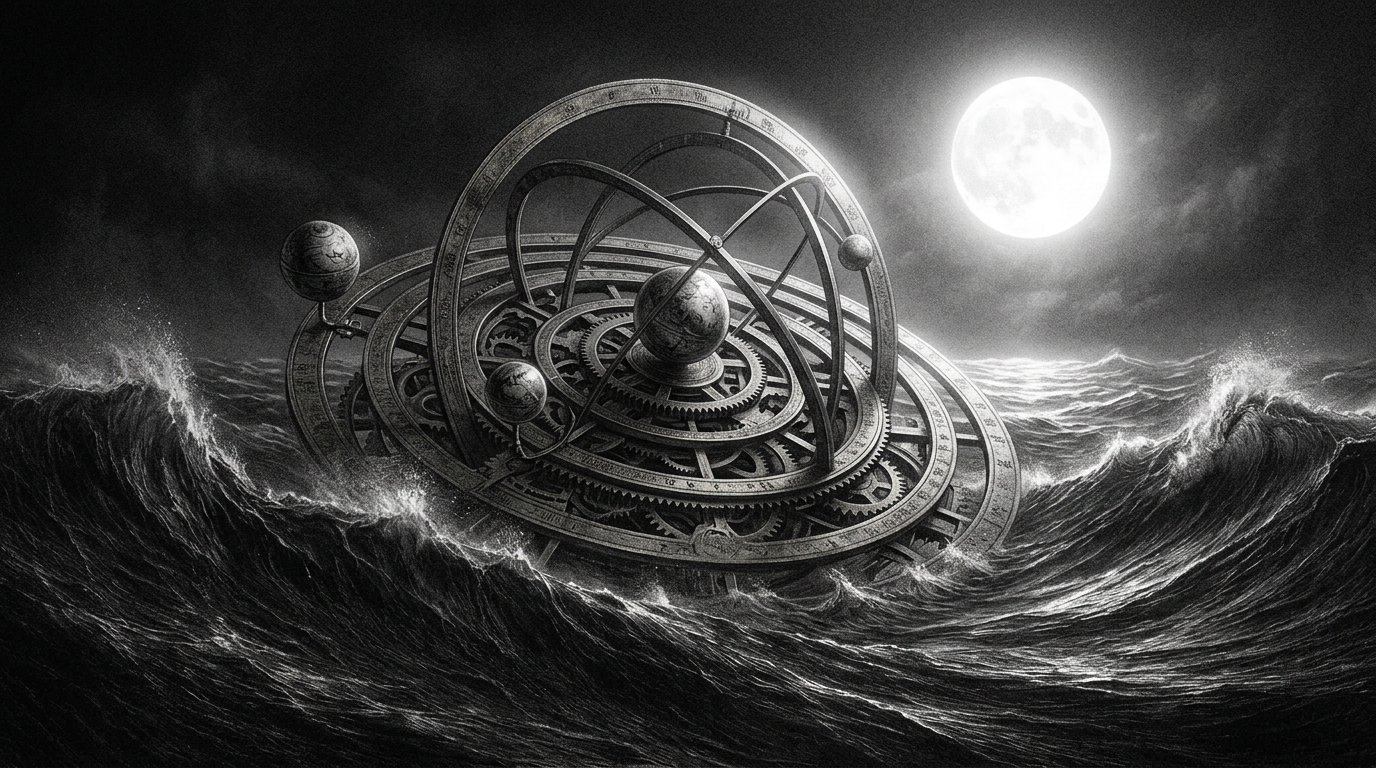
Science is humanity's most successful method for mapping reality. It is also a method with a blind spot it rarely looks at directly – much like the sun: too central to ignore, too blinding to observe head-on.
This is not about individual mistakes or corrupt institutions. It is about something more fundamental: each paradigm defines not only what we know, but also what counts as a valid question. The dominant physical reductionism rests on a foundation where matter and energy are treated as primary variables, and consciousness follows from there – as a product, an emergent phenomenon, noise generated by neurological complexity. This is not a conclusion we reached. It is a starting assumption we inherit and never examine.
The consequence is that the question of why it feels like anything to exist at all cannot be solved from within the model, because the question exists outside the permissible coordinates. Consciousness is not allowed to be a foundational explanation. It is only allowed to be something that must be explained.
A model with consciousness as its foundation is not less scientific. It is oriented differently. And it solves the problem that the materialist model continuously defers. Not allowing ourselves to integrate both is not a logical position. It is a system protecting its own premises – something no system has ever been particularly good at recognizing about itself.
We can continue searching for ever-smaller fundamental components. What we find is merely the next link in a chain that was hidden in the darkness. Particles that predict new particles. Levels that open onto new levels. The chain can become infinitely long – because its substance emerges from the very thing we aren't looking at. It is a story we tell about reality, not reality itself. And stories are bottomless.
The most sophisticated scientists understand this. But a paradigm that cannot solve its fundamental problem while generating an infinite number of smaller problems is not a paradigm in crisis – it is a paradigm in economic prosperity. The search for this anchor fills accelerators, funds institutions, and justifies generations of brilliant work. That the anchor does not exist on the level where we are searching is no obstacle. Institutions tend to reproduce the questions they already know how to fund, measure, and reward.
It is hard to blame them. In a materialistic world, a bottomless black hole is an incredibly tempting place to throw resources into.
Humanity is beginning to feel the consequences of consistently following this logic.
The problem is not medicine, technology, or convenience in itself. The problem arises when solutions are used to readapt people to the very environments that made them sick in the first place.
When stress is treated so the pace of work can continue and loneliness is treated with more distraction.
When existential emptiness is filled with consumption and people learn to tolerate relationships, work environments, and life structures that their bodies have already tried to signal are wrong.
The symptom is relieved.
The cause remains.
Systems tend to reproduce behaviors that stabilize themselves. A society built on external growth naturally favors solutions that direct our gaze outward rather than inward.
When a civilization organizes itself around the measurable, the human tends to be understood through the same logic. Technology solves the problems that technology creates. Medicine treats the illnesses that the lifestyle produces. Efficiency optimizes away the very thing that made life worth optimizing. It is a paradigm that remains consistent all the way to absurdity – and thus drives itself toward its own ultimate consequences.
We cannot continue much further in this direction without ending up with cold technology instead of warmth, treatment instead of health, communication instead of connection.
The realization comes, sooner or later. And when the coin flips, the whole world flips with it. Pole shifts are painful – on a planetary level, on a collective level, on an individual level.
The individual collapse happens every day, unseen, without the system having a language for it. When the story of who one is begins to dissolve, a question emerges that the paradigm cannot answer. Like a physical event. Without guidance, without a name for what is happening, without a culture that has built this threshold into its calendar – one crosses it alone.
It is the paradigm collapse on an individual level. And its structure is identical to what is now happening collectively.
Paradigms do not collapse because of arguments. They collapse when enough people no longer recognize themselves in the story they were expected to live inside.
The deadlock we just described – the compulsion to choose sides, the inability to hold both models at once – is not a flaw accidentally built into the system. It is a direct and visible consequence of the fundamental function of consciousness.
Consciousness requires distinction. It requires a this versus a not-this. To experience anything, a large part of reality must always remain shrouded in darkness – otherwise, there is nothing to experience. It is impossible to experience everything simultaneously. Perspective itself requires limitation.
This means that science's blindness to consciousness is not a historical mistake. It is an expression of the very thing it cannot see – that all seeing requires an angle, all understanding requires an outside, all light requires a surrounding darkness.
But the question of consciousness is different from other paradigm questions. It cannot be delegated to experts. It touches every human being directly – what am I, why do I experience, what is actually happening here? It is personal in a way that makes it impossible to ignore forever.
We cannot stand outside and see the whole.
A complete answer would be pure information – or a state of being beyond human concepts.
No difference between observer and observed.
No story.
No time.
No movement.
Only that which is – before anything is divided into self and other.
And there, the paradox arises.
Separation exists for the same reason we exist: so that something can be experienced at all.
We exist in limitation.
In perspective.
In the forgetting of the whole.
What we call progress simultaneously drives us back toward that from which we were once fragmented.
And if we make it all the way, there is no longer a 'we'.
Only a state beyond human concepts.
Only that which was always there.
Do we want to go there?
Published May 17, 2026