Elon Musk says he believes in Spinoza's God.
Spinoza didn’t describe a god who sits outside of creation, steering it from without. His God is substance itself – everything that exists is an expression of the same single reality. My own thinking tends to move in that direction too. It borders on panpsychism: consciousness is not a byproduct of matter; it is fundamental. All is consciousness in different forms. I agree with that fully.
He also says that the universe might be a simulation run by higher beings who don’t know how it ends. As an analogy, that too points to something real. I agree with that as a possibility, too.
But he never says it’s an analogy.
And what he doesn’t say is always more revealing than what he does. Because Spinoza’s God and the simulation logic point in opposite directions. One says: all is one, consciousness is primary. The other says: you are data in someone else’s experiment, in a system you don’t control. Tech dogma.
He chooses the latter. But first he buys Twitter - one of the largest channels through which people form opinions about reality.
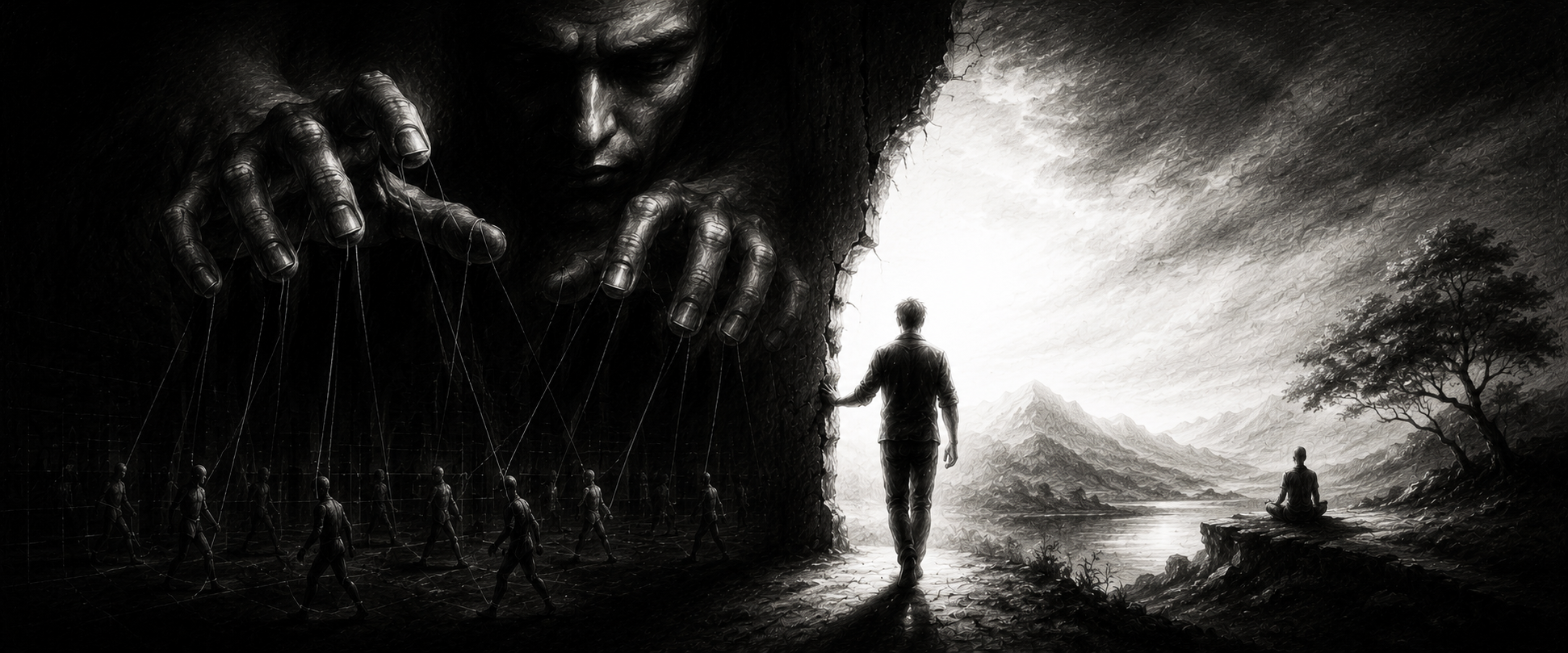
It resembles a classic power move: own the channel that shapes what people believe and act as an intermediary between the individual and direct experience. Make the individual dependent on external authority. The Pharaoh stood between you and the gods. The priest stood between you and the divine. Science tends to grant higher status to what can be measured than to what can only be experienced.
What makes this historically unique is that the very tool that could have freed humanity – a global communication network without borders – is being turned into the new dogma. This time, in a tech guise. Musk now owns one of the world's largest communication platforms and therefore has unusual influence over which conversations receive visibility. He doesn’t need to censor, only to amplify. Under the argument "free speech". What he chooses to manifest on the platform becomes reality for those who live in it.
But it has always been a free choice to follow the story. No one is forced. The intermediary only works as long as you let it stand there.
The Narrative as a Cage
The collective is always led by narratives – it’s how reality reaches us. When a narrative no longer holds, when people start to see it for what it is, they often perceive only the lie or the evil behind it. One could say they are being deceived. One could also say they are being led because they themselves are unable to see the truth without a story through which to interpret reality.
Both perspectives are true.
There is really no right or wrong choice between them. Ironically, that too is a story.
When you see narratives and labels for what they are, an abyss opens up because it takes with it all notions of what one is, how things are, and not least – who one is.
Nietzsche spoke of it. “If you gaze long into an abyss, the abyss also gazes into you.”
Seeing through the function of stories isn't simple, either.
What Musk claims is not necessarily wrong as an analogy. My concern is that simulation theory is often presented as a literal description of reality rather than as a metaphor that points beyond itself.
We are used to the idea that what is measurable is what counts.
You can build a model with matter as its foundation.
You can also build a model with consciousness as its foundation.
Both models are scientifically valid, so – why does the latter sound so fanciful? Perhaps because we have been programmed that way?
Just as two eyes provide depth perception and two ears provide stereo sound, both perspectives are needed to see the whole truth. We experience the world through contrasts. In short, this means that hot and cold depend on each other to exist. They define each other – without cold, there is no hot. Together they are one, but seen from different sides.
The Description Is Not the Reality
And yet, we consistently choose to see only one.
Everything external is a narrative. Not reality itself, but our descriptions of it. Science, politics, religion, philosophy – they all rest on assumptions, models, and interpretations. The unfolding is real. The explanation is not. The explanation is just a map of what happens.
It is therefore strange when people speak of truth while their gaze is locked on the external. What they defend is almost always a story about reality, not reality itself.
Public discussions of simulation theory often emphasize the external structure of reality while giving less attention to the role of consciousness itself. Whether intentionally or not, this can reinforce a worldview in which the individual experiences themselves primarily as a component within a larger system.
The other side is seldom visible in the broader cultural narrative surrounding technology, simulation theory, and scientific materialism. Whether he actually dismisses it or just finds it less useful, I don't know. What is hard to ignore is that Musk has openly spoken of experiences – including psychedelic ones – that many describe as something that expands the experience of reality rather than reducing it. Yet the worldview he publicly presents is overwhelmingly material and technological.
Perhaps that is why the narrative has such a strong impact. It reflects the fundamental assumptions of our time: that what can be measured is also what is most real, and that consciousness is something produced by the system rather than that through which the system is experienced at all.
And that is the real problem.
People don't understand.
This is where you must choose which side of the coin you want to live on.
Because if you turn the coin over, you will see something completely different: you are not a byproduct of a system; you are its prerequisite. No simulation can exist without a witness to experience it. This means that it is your consciousness that gives the world color, form, and meaning, here and now. External power can only control you if you forget your own inner compass.
True depth perception is about being able to live within the collective's stories without losing yourself in them. You don’t need to wait for a simulator to give you permission to exist. Freedom and direct experience are already yours – and that is a cage no technology in the world can lock.
A framework that makes people dependent on external validation is simply useful for those who provide that validation. Musk is not unique in this. He is just the clearest current example of a pattern as old as civilization: the person at the top of the hierarchy describes reality in a way that places themselves closest to the source and separates the collective from understanding.
Pharaohs appointed themselves as gods.
The Abrahamic religions took your inner power and placed it in the hands of a judging god and his priests.
Now, the tech giants hold the switch.
You can choose to focus on their narrative – or you can choose to seek for yourself.
Preferably, inward.
After all, you have read this far, so you likely have a good disposition for it.
How We Lost the Center
Scientific materialism – the worldview Musk implicitly leans on – had already made the same move before he arrived. It declared inner knowledge to be invalid. That consciousness is a byproduct. That the subject can be reduced to matter observing matter and calling it knowledge.
For most of our history, it was self-evident that one's own consciousness was the most real thing there was. Both ancient philosophers and the mystics of old assumed that the universe was experienced from the inside out. Your inner compass was the center of everything.
Modern materialism turned this completely on its head and made a historical exception. It declared your inner knowledge invalid and consciousness a mere chemical byproduct. Suddenly, humanity was left completely without its own center. You were reduced to a biological machine that happens to exist in a dead universe – and then you are told that this emptiness is called objectivity.
If inner knowledge is invalid, you must look outward. And outward means to authorities, experts, institutions.
In Musk's version: a simulator you can never reach, run by beings you can never ask. A cosmology of hopelessness.
The deepest question humans can ask – what is this, and why does it exist? – he answered with SpaceX logic.
A cosmology that tastes of venture capital.
The coin has two sides, and Musk has chosen the one that serves him.
On one side: you are a variable in someone else's experiment. Your value is determined by your output. Your continuation depends on external judgment.
On the other side: you are the observer. Not a byproduct of the system, but its prerequisite. The only thing that cannot be simulated away, because the simulation requires a witness – and the witness is you.
You don't get to the other side by waiting for the simulator to reveal itself through physics. You get there by seeing who it is that sees.
Truth Is a Living Circle, Not a Square
But my story, too, has two sides. So far, I have chosen to highlight the negative. This doesn't mean my story is truer than his. Only that it points in a different direction.
Here is the other side of the coin – the bright perspective:
People need stories. Collectives need unifying narratives – without them, things quickly fragment and the law of the strongest takes over. Even that would be called evil. Every civilization and culture is built on a shared story that people, consciously or not, choose to believe in. More or less.
In that sense, Musk is not doing anything uniquely villainous. He does what every powerful person does: he writes a story and invites the world to live in it. The story is not evil. No story is. A story is just a story.
The question is whether you know you're living in one.
For there is a silent but absolute difference – choosing between being the author of a story or an echo and character in someone else's work. Between one who consciously chooses a story and one who never realizes there is a choice. Every explanation in the world is a story. So, if one wants to be a little charitable, one could say that the cage is not really built of lies but through people's assumption that the story is reality.
That is why everything begins in silence.
Only when a person meets themselves beyond their stories can they meet others without seeing difference as a threat. Disagreements are then no longer problems to be solved, but expressions of different perspectives on the same reality.
Perhaps the closest we come to truth is not any single story, but the ability to see through them all.
This, too, is a story.
People have been trying to explain this for thousands of years. But because truth degrades the moment it is translated into words, every attempt always results in its own story.
It's a bit like trying to explain a chair to someone who only knows two dimensions.
It is impossible to describe the chair fully. You can only show its shadows. The shadows are real, but they are not the chair itself. They are traces of something larger that doesn't fit within the frame of reference the person has access to.
We can sometimes sense or experience things that are difficult to translate into language because language and concepts are not always sufficient. Science already knows that the brain can create and handle models far more complex than what we can easily formulate in words.
That is why one can sometimes see something within oneself without being able to explain it.
The ability to see cannot be given by anyone else. It must be discovered. Because information, for now, travels through 3D space. There, it breaks down into a silly story.
The collective's attention is almost always directed outward.
What is required for understanding is often found inward.
In the external, we chase answers.In the internal, understanding arises only when the pace slows down.
The prerequisites for understanding are therefore not something you find. you must choose them for yourself.
The tech dogma is coming. It is already taking shape. A new priesthood with a new cosmology, and at its center – as always – an authority that stands between you and the real.
You will not be free unless you free yourself.
That sentence sounds simple. It is not. To free oneself does not mean rejecting science, dismissing technology, or retreating from the world. It means refusing to outsource the one thing that cannot be outsourced: the direct encounter with your own consciousness. No billionaire's cosmology can place it outside of you unless you let them.
This is not a new idea. It has appeared repeatedly throughout history, often overshadowed by systems that place greater emphasis on external authority than on direct experience.
That is my reality.
If you wish to explore this further, not as a doctrine but as a direct inquiry, that is what Holy Paradox is about.
Published June 1, 2026