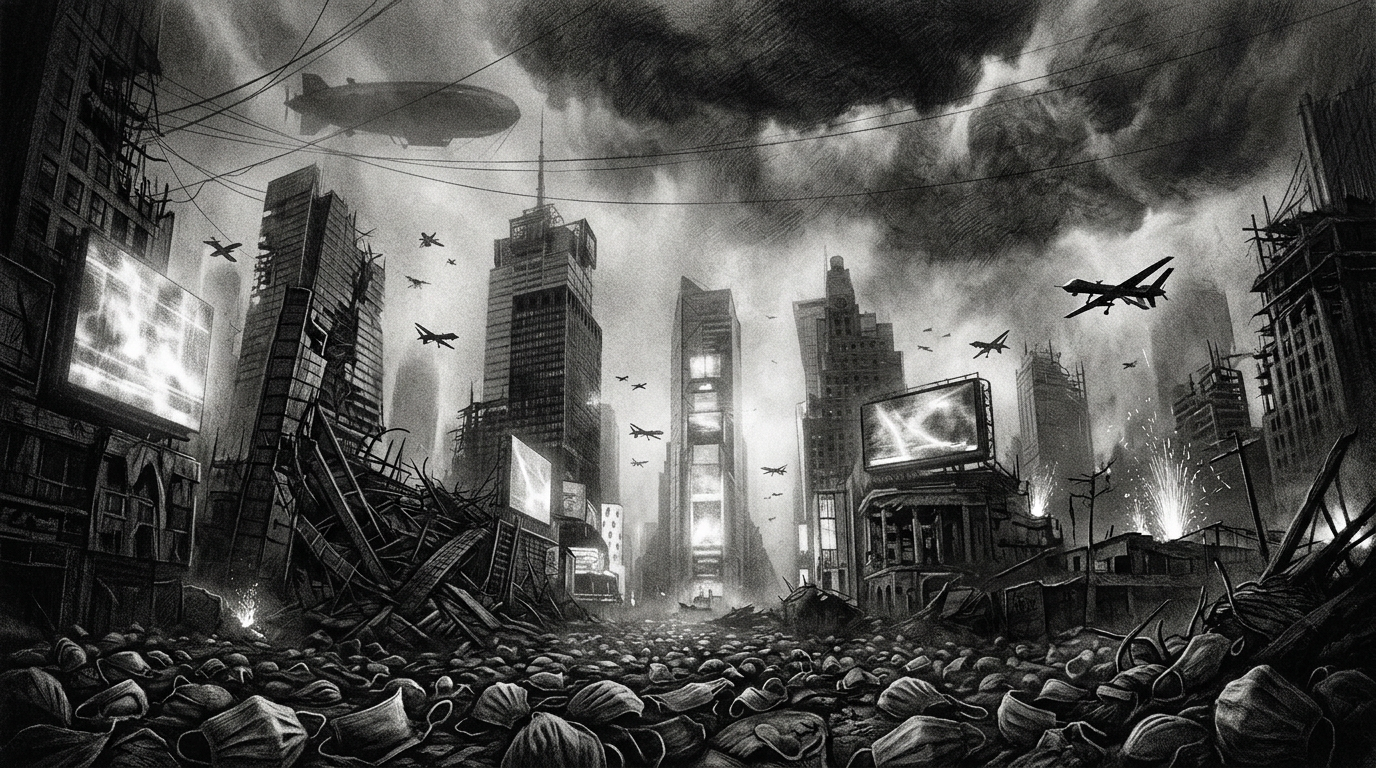
Something feels off. Institutions are losing their grip. Authority is questioned everywhere. Pandemics appear, reshape society, and leave behind new rules that didn't exist before. People who used to agree on basic facts no longer share the same reality. If you've been wondering whether there's a pattern underneath all of this – there is. But it's deeper than politics, deeper than economics, and deeper than any single ideology can contain.
The explanation isn't comfortable. The forces that benefit from things staying as they are are real, they have tools, and some of those tools are very dark. I'm not going to soften that. But the direction of travel is also real – and understanding what's actually happening is, I think, more useful than not understanding it.
What follows is my attempt to explain it clearly. I put the core questions to an AI to get the structural answers laid out without sentiment and edited the text. But the framing is mine – and so is the reason for writing this at all.
This project exists because of the state of the world. That state is what this essay is about. The deeper understanding is what The Holy Paradox is for.
Two ways of modelling the world
Everything you've been taught about reality rests on one assumption: matter is primary. The brain produces consciousness. The physical world is what's real. Everything else – experience, meaning, awareness itself – is a byproduct, an epiphenomenon, a story the brain tells itself.
This assumption runs so deep in modern culture that questioning it sounds like irrationality. But science is quietly, steadily arriving at its edge. Quantum mechanics has been pointing toward something strange for a century: observation affects reality. Consciousness can't be neatly explained by the physical. The "hard problem" – why there is subjective experience at all – remains completely unsolved.
Model 1 – Current mainstream: Matter is primary
Consciousness emerges from physical processes. Reality exists independently of the observer. You are a body that happens to think.
Model 2 – Emerging view: Consciousness is primary
What's being tentatively proposed, by physicists and philosophers of mind alike, is the opposite arrangement: matter is a projection of or within consciousness. The observer is fundamental. You are awareness that happens to have a body.
Two eyes are better than one
The important point – and this is what makes it genuinely difficult to dismiss – is that you don't have to pick one. As the physicist Niels Bohr spent much of his career trying to articulate, these might be complementary perspectives on the same reality, like wave and particle in quantum mechanics. Two true descriptions of one thing, each valid in its own domain.
Think of it this way. We have two eyes to get depth perception. Two ears to get stereo. A single channel gives you a flat image. Combine the outer, measurable world with the inner, experienced world – and the picture gains a dimension most people haven't been using.
A simple map of where humanity stands:
00 – Both channels closed. Disconnected from inner and outer both.
01 – Outer understanding only. Science, data, measurement. Most of modern civilisation.
10 – Inner understanding only. Mysticism without grounding. Prone to delusion.
11 – Both. Depth perception. The integration science is slowly approaching.
We have been, collectively, in 01. After the devastation of the Second World War, the priority was reconstruction – action, output, measurable progress. The inward dimension got set aside. The timing made sense. But the timing has changed.
"I regard consciousness as fundamental. I regard matter as derivative from consciousness. We cannot get behind consciousness."
– Max Planck, The Observer, 1931
"Consciousness cannot be accounted for in physical terms. For consciousness is absolutely fundamental. It cannot be accounted for in terms of anything else."
– Erwin Schrödinger, What Is Life?, 1944
These weren't fringe figures. Planck founded quantum theory. Schrödinger's equation is the basis of modern physics. They knew what they were saying – and they said it anyway.
Why this is a threat to existing power
Every major power structure in modern civilisation rests on the materialist model. It is the architecture. Change the foundation and the building changes with it, whether anyone intends it to or not.
Here's how the pillars actually work:
Epistemological authority. Science owns the definition of what counts as real. Only the measurable matters. If inner experience regains its epistemic standing – if what you directly know can't be dismissed – that monopoly breaks. People become harder to gaslight about their own reality.
The economics of incompleteness. Consumer capitalism runs on people feeling not enough – seeking fullness through acquisition, status, external validation. A person who doesn't experience themselves as fundamentally lacking is a different kind of economic subject. They buy differently. They refuse differently.
The intermediary model. Churches, parties, media, expert classes – all operate by positioning themselves between the individual and truth. Direct access to reality threatens the entire business model of spiritual and political authority. It always has. That's why mystics have always been treated as either saints or heretics, rarely anything in between.
Death as a control mechanism. The materialist model guarantees the absolute finality of death. That terror is perhaps the most powerful lever of control available. A person who holds their own mortality differently – who understands consciousness as primary, and the body as a temporary form – is simply harder to threaten.
The immune response – and it can get very dark
Before describing how the system responds, it's worth being precise about what "the system" actually is. Because the standard objection to this kind of analysis is: surely a coordinated suppression would require thousands of people acting in concert, in secret. That objection is correct – if that's what's being claimed. It isn't.
Think of it as three distinct layers, operating simultaneously and largely independently of each other.
At the top
A small number of people who understand the game fully and play it consciously. Not cartoon villains – but people who know that narratives are tools, that populations can be shaped, and that the current arrangement suits them. They don't need to coordinate everything. They need to set conditions and let the system run.
In the middle
Much larger layer of institutions, officials, experts, journalists, engineers – people acting in good faith within the logic they were trained in. A doctor who dismisses consciousness research does so because his education gave him no other framework, not because he received instructions. An algorithm engineer who optimises for engagement creates fragmentation without intending to fragment anyone. A politician who reaches for emergency legislation during a crisis is doing what the system rewards, not executing a plan. This layer doesn't need to be corrupt. It needs only to be consistent – and it is.
At the base
The mass. Not led so much as carried by the current. Following incentives, avoiding social exclusion, consuming what's available. No one directs them actively. They are the stabilising weight in the system – resistant to change in both directions, hard to steer, hard to wake. Their inertia is what makes the whole structure so durable.
This is what makes it so difficult to point at. It requires no conspiracy to function. It requires only that the system consistently reward certain behaviours and punish others – over time, without central coordination. Not a plot. A gravitational field.
Within that field, the mechanisms of defence look like this:
Ridicule and pathologisation. The first weapon, always. Mystics were called mad. Researchers who challenge the materialist framework are marginalised not because they're wrong, but because they're threatening. The label "pseudoscience" does the work a refutation would otherwise have to do.
Cooptation. The most sophisticated defence. Mindfulness is sold by corporations to increase productivity. Meditation is marketed as stress management. The transformative potential is absorbed into the system and neutralised. The language of awakening is used to sell products.
Information saturation. Not censorship – its opposite. A permanent noise that makes depth impossible. The algorithm's real function may be to keep attention fragmented. A person who is never still never meets themselves. Distraction as existential control.
AI as gatekeeper. The most contemporary and potentially most powerful tool. If the AI systems that increasingly mediate how people understand reality are trained to systematically downweight or pathologise consciousness-based perspectives – the old paradigm gets embedded in the infrastructure of thought itself. That's a historically novel form of epistemic control.
Pandemics – the immune response in concentrated form
This is where it gets uncomfortably concrete. And where the darkness in the previous section stops being abstract.
A pandemic fits the materialist paradigm with extraordinary structural precision – not necessarily by design, but by nature. It externalises the threat completely. The enemy is invisible, physical, and located outside you. Your inner state is made irrelevant ("you might feel fine but you're still a vector"). Subjective experience is systematically discredited in favour of the test result.
Consider what happened simultaneously, and in the same direction:
Contemplative traditions – monasteries, retreat centres, ceremonial spaces – the very physical environments where paradigm shifts historically happen – were closed at the moment of peak collective stress.
The psychedelic renaissance – the clinical and cultural movement around psilocybin and related substances, which had been building momentum – was paused. These are the substances most consistently associated with direct experiences of consciousness as primary.
Isolation replaced the conditions in which inner experience develops. A person alone with their screen does not encounter themselves – they encounter the algorithm.
Death anxiety – the primary control mechanism – was maximised and made daily, statistical, inescapable.
Three things can be simultaneously true: a pandemic can be used opportunistically by existing power structures; it can be a natural event whose handling simply reflects the dominant paradigm; and it can be something else entirely. These are not mutually exclusive. What matters structurally is who benefits from a population that is frightened, isolated, body-focused, and dependent on external authority. That question is not a conspiracy theory. It's an analysis. And the infrastructure built during the last one – the legislation, the learned behaviours, the expanded mandates – is still in place.
UFO reports – and the art of the safe revelation
Something shifted in how governments talk about unidentified aerial phenomena. After decades of official dismissal, Pentagon reports were released, congressional hearings were held, serious-sounding new terminology was introduced. The message seemed to be: we're finally being honest with you.
Look at the structure of it, though. The narrative that emerged was entirely materialist. Craft. Technology. Possible foreign adversaries. Unknown physical objects doing things physics shouldn't allow. The framing kept the mystery firmly in the outer world – in the domain of military intelligence, aerospace engineering, and geopolitical threat assessment. Whatever UAPs are, the official conversation ensures that the question stays in 01.
What's consistently absent from the institutional framing is the one thread that most people who have had close encounter experiences actually report: something that happened to their consciousness. Shifts in perception. Dissolution of the boundary between self and world. Experiences that sound less like seeing an aircraft and more like the accounts of people who have undergone deep meditative or psychedelic states. That dimension – the one that would actually threaten the paradigm – is nowhere in the official narrative.
Controlled disclosure is still control. Releasing a mystery on your own terms, in a form that keeps attention pointed outward, is not transparency. It's narrative management at a higher level of sophistication. The population gets something real enough to feel like honesty. Nothing changes about how they understand themselves.
The coin has two sides – and both are real
Here is the hardest thing to sit with in all of this.
A collective needs a shared narrative to function. Not as manipulation – as necessity. Societies are held together by stories about who we are, what threatens us, what we're building toward. The people who maintain those narratives aren't all cynics. Many of them genuinely believe they are doing what is needed to hold things together. The line between keeping people safe within a story and keeping people away from their own capacity is not always visible, even to those drawing it.
The uncomfortable question isn't whether we're being managed. We are – we always have been. The question is what kind of management, in whose interest, and at what cost to what's possible.
And here is where the coin shows its other side.
The majority of people do not have access to – and will not develop access to – the kind of understanding described in this essay. That's not condescension; it's an observation about time, circumstance, and the conditions under which inner development becomes possible. Most people are fully occupied surviving, raising children, managing anxiety, staying entertained. The 11 state is not available on demand.
What the majority can reach – and what the current collapse of institutional credibility is steadily producing – is the feeling of having been deceived. That is a real and legitimate response. But it is not the same as understanding. A person who has woken up to the fact that they were lied to is still, in the framework of this essay, in 01. They have updated the content of their external model. They haven't changed their relationship to their own consciousness.
Which means: the most likely mass outcome of this paradigm transition is not collective awakening. It is collective disillusionment. Anger at the old narratives without the inner resources to build new ones. That vacuum is as dangerous as the control it replaces – and historically, it's exactly the kind of moment that produces new forms of authoritarian simplicity. Someone always arrives with a cleaner story.
The coin, honestly held: the shift is real and the direction is toward something more whole. And the path there runs through a period that is genuinely dark, genuinely unstable, and offers no guarantees about what fills the space when the old structures come down.
Where this goes
In the short term – the next ten to twenty years – we are in chaotic transition. Institutional authority is collapsing faster than new structures can be built. The vacuum fills with everything simultaneously: genuine awakening and conspiracy thinking, new religious movements and authoritarian nostalgia. The paradigm shift and its backlash are happening in parallel and are very difficult to tell apart from inside.
The dystopian path: control intensifies precisely because the threat is real. Surveillance deepens. AI entrenches the old narrative. Spiritual movements are cooptated or stigmatised. The majority reaches "we were lied to" – and stops there, available for the next simpler story. That is not awakening. That is a change of cage.
The other path: a critical mass reaches an understanding that makes them practically uncontrollable as consumers and subjects. Not through opposition – through indifference. The system that runs on fear, desire, and external validation simply loses its fuel supply. That is not a revolution. That is being outgrown.
Over the longer arc, science expands rather than collapses. The first-person and third-person perspectives are recognised as complementary epistemologies. Death loses its role as the ultimate control mechanism. It is difficult to overstate what that does to a civilisation.
Paradigm shifts don't happen when the majority changes its opinion. They happen when enough people live differently – and when the old system's costs exceed its ability to sustain its own credibility. Both of those are already underway. The friction you see is not evidence that the shift is failing. It is evidence that the shift is happening. Whether what replaces the old structure is better depends entirely on how many people get far enough inside themselves to know the difference.
The rebellion that can't be stopped
(Back to Authors own words)
Most people picture rebellion as opposition – protest, resistance, confrontation. But opposition requires an opponent. The opponent stays necessary. The cage changes shape but remains a cage.
The rebellion this essay is pointing toward looks nothing like that. It is the withdrawal of fuel. The system runs on fear, desire, and the felt sense of incompleteness. A person who has genuinely shifted their relationship to their own consciousness stops being a reliable energy source for any of it. Not through discipline or ideology – through indifference. They buy differently. They refuse differently. They are harder to frighten.
That is the rebellion. And it is invisible. It produces no images. It has no leaders to arrest, no movement to infiltrate, no demands to negotiate with. It cannot be cooptated because it is not organised around anything external.
This is also why it is rare. Most people who feel the system is broken will stop at disillusionment. That is real and legitimate – but it is not the same thing. Disillusionment without inner resources just creates a vacancy. And someone always arrives with a cleaner story to fill it.
The rebellion that actually threatens the paradigm is not a movement. It is a threshold – crossed quietly, one person at a time, with no announcement.
And to everyone still in 01, it will look exactly like passivity. Like giving up. Like not caring enough. Like being part of the problem. Which is exactly what makes it so difficult to explain – and so easy to dismiss.
Published May 13, 2026